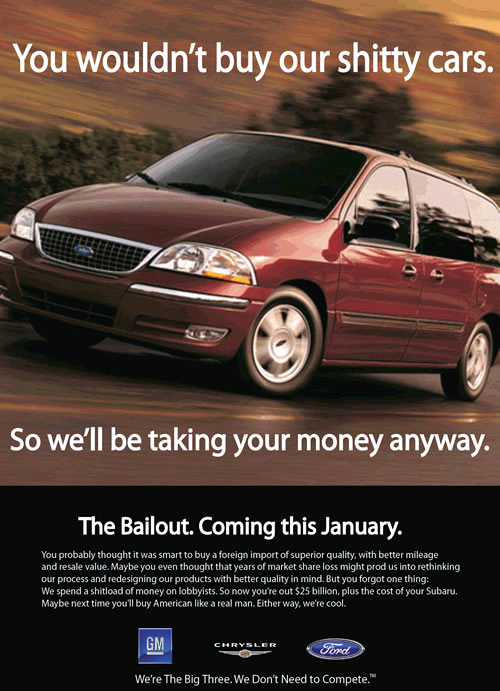
I’m sure you’ve seen the parody poster by now: “You didn’t want to buy our shitty cars, so we’ll be taking your money anyways. All the news outlets are saying that the White House might tap TARP funds to provide immediate assistance to the Big Three, since the Senate unceremoniously shot them down the other night. As a lifelong metro-Detroiter, I feel obliged to comment on such happenings.
Yes, a reorganization or a bankruptcy, a complete failure would be disastrous for the local economy in the short-run. But I’m not convinced that a bailout will make anything better in the long-run, and even if I were so convinced, I’d still be morally opposed to subsidizing abject failure.
On that note, GM would need to triple its 3Q sales volume in order to remain solvent. The plain fact of the matter is, it doesn’t matter how much labor commands in compensation, as long as they’re building cars that nobody wants to buy. As long as their lead time is 25% greater than the competition. As long as their defects per vehicle is 3x the competition. As long as they cost more than comparable vehicles from other manufacturers. IF YOU BUILD CARS THAT NOBODY WANTS TO BUY, YOU WILL QUICKLY FIND YOURSELF IN FINANCIAL DISTRESS.
Some people blame management for the mess. I am certainly not apologizing for, nor do I intend to absolve the Big Three for the errors of their ways:
GM’s management drove the company into the ground, by consolidating many of their suppliers under their umbrella: one problem this created was a concentration of power such that a single Delphi strike could shut down the General. Additionally, because of GM’s enormous market share, it’s possible that they could drive domestic manufacturing to total collapse. If one automotive supplier goes under, the manufacturers simply source from someone else’s stamping plant. If one manufacturer goes out of business, every single supplier under their umbrella takes a massive financial hit.
In all fairness, many of these independent shops should’ve long ago thrown in the towel, and they likely would’ve, had the Big Three not been the beneficiary of many state subsidies throughout the years. There’s an old saying that warns us about putting all the eggs in one basket. This is a big problem with State capitalism which does not merely permit, but actively encourages the oligopolization of industry, as we’ve seen with the domestic auto manufacturers over the course of the last century.
Other people like to blame labor, and the extravagant $73/hour that they all earn. Except they don’t make that much money, which would be about $150k/year. They make (on average) something closer to $30 an hour, or somewhere in the neighborhood of $60,000 annually. Add overtime and bonuses (when times were better, assembly-line workers were getting $20k at Christmas), and the average line worker can certainly be in the upper strata of “middle class”.
The $73 figure, as others have pointed out by now, comes from the current costs associated with retiree benefits. According to the NYT,
These are essentially fixed costs that have no relation to how many vehicles the companies make. But they are a real cost, so the companies add them into the mix
If this is not accounting chicanery, it ought to be. Why don’t the Big Three add their other fixed costs into labor calculations? Plant assets, capital equipment, etc., are all “fixed costs” in a true sense. In any event, the total cost of their compensation is about $55 an hour which is still “twice as much as the typical American worker makes, benefits included” and something like 20% higher than the rest of the domestic (foreign-owned) auto industry.
However, I want to put everything out in the open: The UAW is still a labor cartel, no matter how you want to romanticize it. By directly limiting membership, they are able to indirectly command certain levels of compensation, and control (at least to some extent) the amount of overtime available to them. Especially in Michigan, they have historically been anti-productive and anti-labor and anti-employment:
Unions prefer to keep many able-bodied workers unemployed in order to force their higher wages on their employers. Big Labor in Michigan is continually fighting to keep businesses out of the state.
If the UAW thinks General Motors is salvageable, let them put their money where their mouths are. General Motors real value is approximately zero. The UAW should let General Motors fail, they should be rooting for bankruptcy. The UAW should buy all of the debts and assets and obligations from the bankruptcy at pennies on the dollar. Anything else is just proof that they’d like someone else to subsidize their existence.