I spent the last week studying at the Ludwig von Mises Institute in Auburn, AL. Went out on the town a few nights, met some people, had a good time. Listened to some engaging speakers – notably Roger Garrison, whose work on Business Cycle Theory will be of great help to me, and Jörg Guido Hülsmann, who delivered an amazing lecture on further explorations of the theory of interest rates.
Needless to say, walking back into the monotony that is my daily routine, I’m thoroughly disappointed. To go from an environment wherein your intellect is being constantly stimulated and pushed ever-further, to a dull job where I do nothing of any import or difficulty, is like coming of a week-long bender. Like the alcoholic who needs booze to feel “normal,” I feel probably lower than I ought to. And having a Finance exam this week, for which I have not adequately studied (it’s supposed to be tonight, but I should have an extension until Wednesday) isn’t helping.
I did spend about $100 on books there, a few new ones and a few used ones, which were bargain basement prices. I think I went home with 11 books in all. I’ve just started reading Mises’ Theory of Money & Credit, and I also picked up a copy (at the student-discount price of $36) of Jesus Huerta de Soto’s Money, Bank Credit, and Economic Cycles. I don’t know if I’ll have the guts to try and tackle that page by page – rather I’ll probably end up reading bits and pieces of it, referentially, as curiousity or necessity dictates.
The one that I’ve already finished reading, however, is an absolute gem:
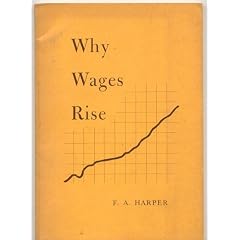
Originally published in 1957, F.A. Harper’s Why Wages Rise is a fairly short volume, and it’s elegantly simple and complete. With clarity, Harper demonstrates that Carl Menger’s theory of marginal utility will be the ultimate arbiter of the wage rate(s) and ough to lead to the optimal level of employment. Harper admonishes trade Unions and demonstrates the ill-effects they’d had on the economy even at that point in history, when their dominance was at its climax. I purchased it for $3, which seems fair enough, because the Foundation for Economic Education and the publisher give explicit written permission to reproduce the volume in part or in its entirety, which is why I’m confused as to why it’s going for about $100 on Amazon. Even at that rate, however, I don’t plan on giving it up – I see it as a reference point and a collector’s item.
I also picked up The Mainspring of Human Progress for $1 on a recommendation from a classmate, and Gene Callahan’s 2nd Edition of Economics for Real People for $4. At those prices, I couldn’t afford to not buy them.
If you’ve got any suggestions for me to add to my reading list, comment please!
